Thank you!
More to come—we’ll be in touch shortly.

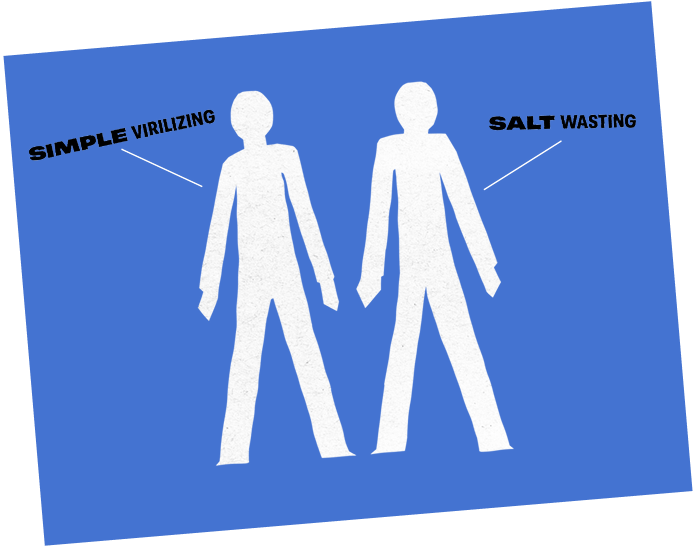
Both forms of classic CAH can be life-threatening if left untreated.
What do these hormones do?
Managing CAH has two key goals:
Download a handy guide that breaks down what you need to know, all in one place.
Whether talking to friends, coworkers, or teachers, explaining CAH to others can be a challenge. If you’re tired of going through it all yet again, share this video for an easy-to-follow (really!) introduction to CAH.
Length: 3:28
Understanding CAH: A Guide to the Basics
[Adult VO 1 — female, 35-45]
One of my students this year has a condition I’m not familiar with. It’s called CAH.
[Adult VO 2 — male, early 30s]
A guy on my team at work told me he has CAH—I haven’t heard of it before.
[Adult VO 3 — female, early-mid 20s]
My new roommate let me know she has CAH.
[Adult VO 2 — male]
Wait. What is CAH?
[Narrator VO]
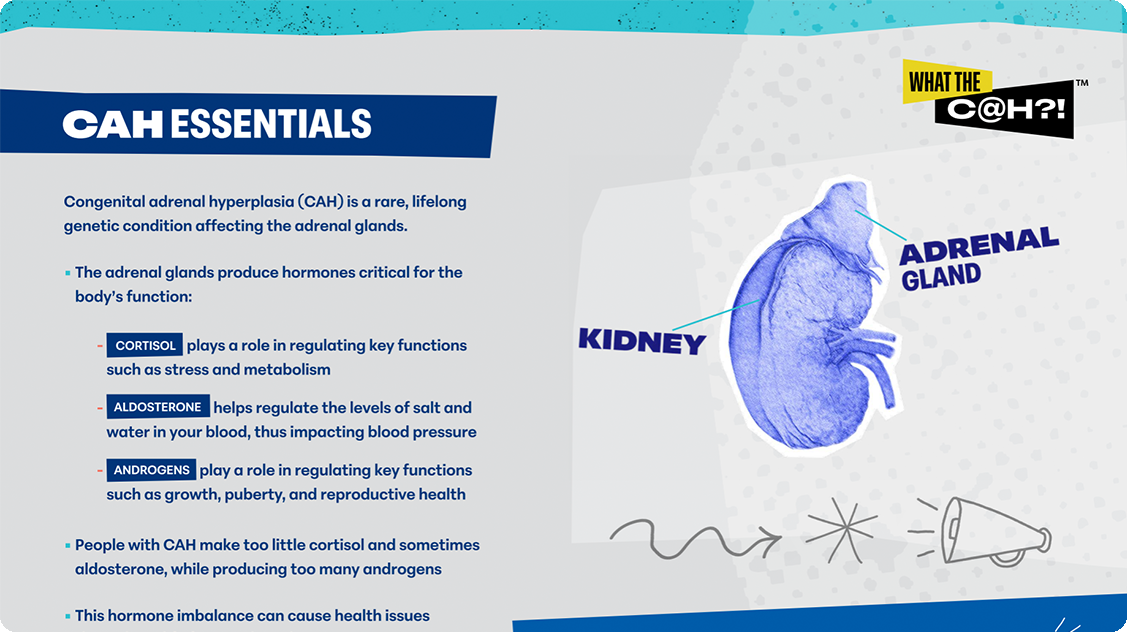
CAH, or congenital adrenal hyperplasia, is a rare, lifelong, genetic, condition.
CAH is usually detected at birth. In the United States, all newborns are now tested for CAH to help prevent complications and even death.
[Adult VO 3 — female]
It sounds serious.
[Narrator VO]
It is. But there are treatments that can help manage it and enable people with CAH to focus on living their lives.
[Adult 2 VO — male]
So, what does CAH mean for someone who has it?
[Narrator VO]
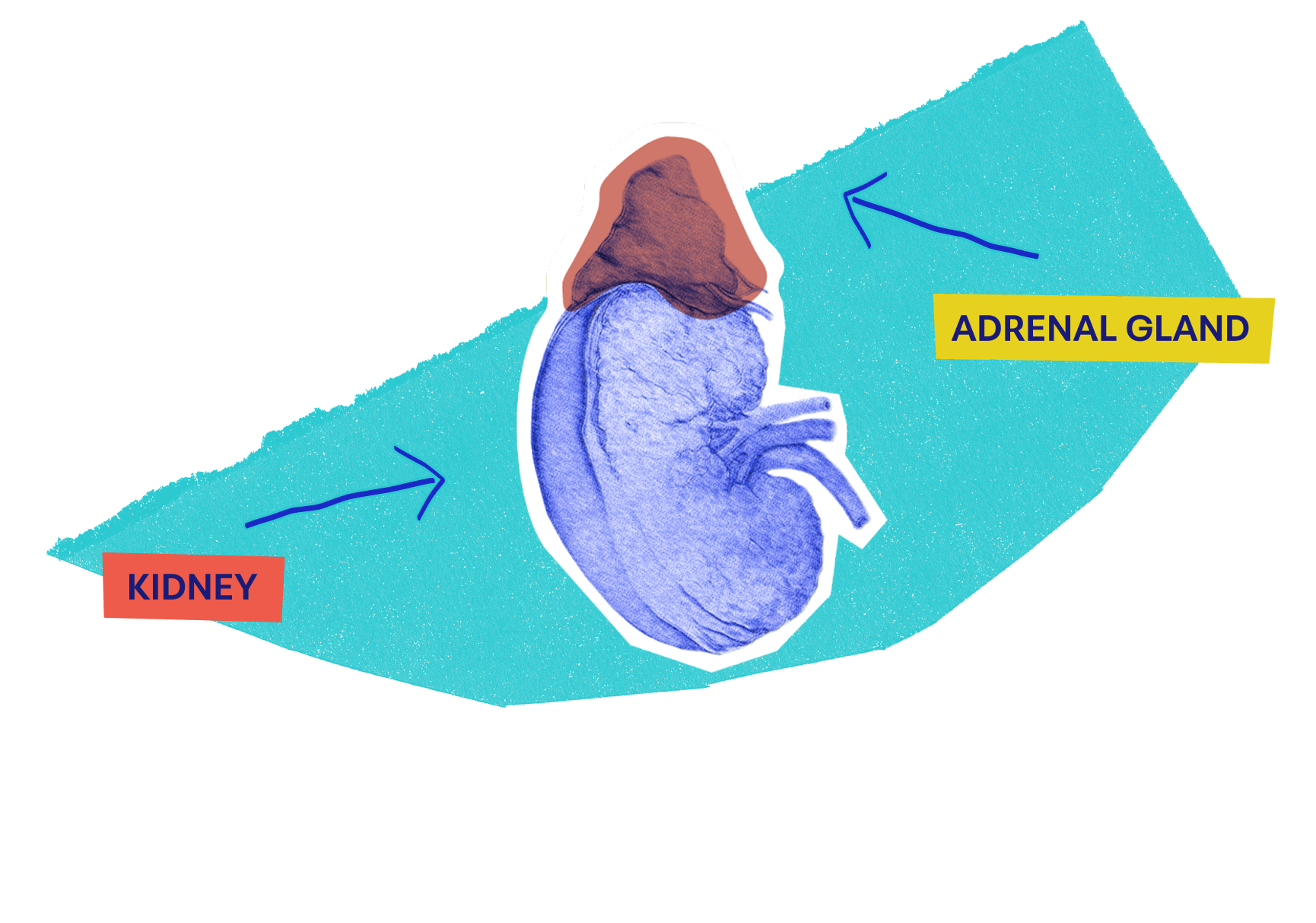
Well, CAH affects three important hormones that help our bodies function: cortisol, aldosterone, and androgens.
We all need cortisol to stay alive. It’s sometimes called the stress hormone, because your body makes extra when needed, like when you’re ill or you overexert yourself. Cortisol also regulates your metabolism. Together, cortisol and aldosterone help your body maintain a healthy blood pressure.
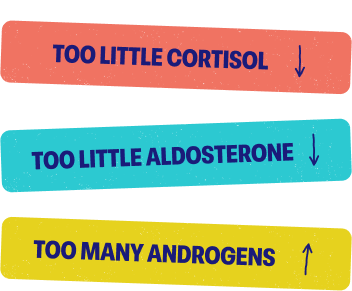
But in people with CAH, the body doesn’t make enough cortisol and aldosterone.
[Adult VO 2 — male]
We’re all under the weather from time to time. But my coworker says that when he’s feeling bad, it could be a sign of something much worse, especially if he feels nauseated, very weak, or dizzy.
[Narrator VO]
That’s right – for those with CAH, feeling unwell could be a warning for what’s called adrenal crisis—this is the life-threatening part of CAH, and it happens in situations when the body needs more cortisol than it’s able to make. There’s an emergency injection in case adrenal crisis happens.
[Adult VO 1 — female]
I carry that for my student on field trips. You also mentioned androgens – what do those have to do with CAH?
[Narrator VO]
When cortisol is low, the brain releases CRF—a signal received by CRF1 receptors in the pituitary gland. This sets off a chain reaction that, in CAH, contributes to excess androgens.
Androgens affect growth and reproductive health, but having too many can disrupt these processes in the body.
[Adult VO 3 — female]
My roommate says CAH makes her periods irregular, and that it might be harder for her to get pregnant because of her CAH.
[Narrator VO]
That’s right – fertility for both men and women can be impacted due to CAH. In kids, excess androgens can cause symptoms like early puberty and acne.
[Adult VO 3 — female]
I’m so glad to know all this. Besides the emergency injection, what other treatments are available?
[Narrator VO]
Prescription steroids called glucocorticoids and mineralocorticoids are used to replace cortisol and aldosterone. Sometimes higher doses of glucocorticoids are needed to help reduce excess androgens. However, these higher doses have drawbacks – they can cause side effects, some of them serious, such as weight gain, bone density issues, diabetes and even depression.
There’s another way to manage androgens too—one that works independently of steroids.
CRF1 receptor antagonists block the CRF signal at the source—reducing the chain reaction that can lead to excess ACTH and androgens.
They don't replace steroids, which are still used to replace missing cortisol—but they may help reduce the amount of steroids needed.
[Adult VO 1 — female]
I’m glad to know the basics, so I can help if necessary.
[Adult VO 2 — male]
It makes me feel like I can be there for them.
[Narrator VO]
CAH can be frustrating, but a supportive community could make it just a little bit easier.
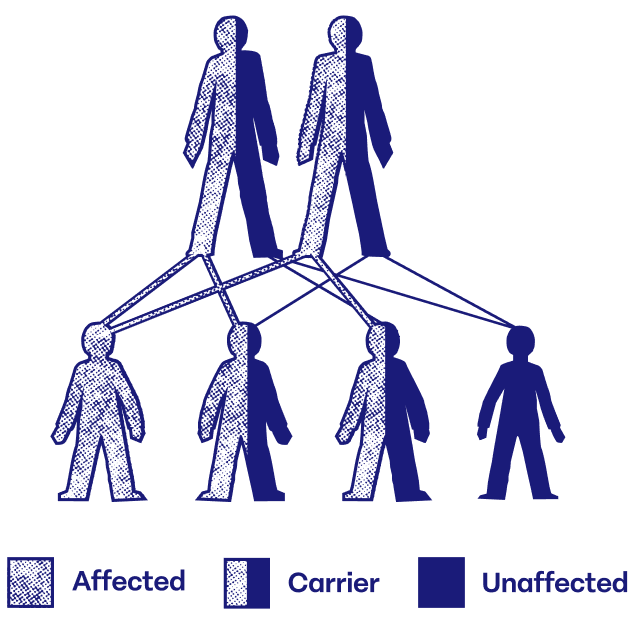
CAH is a genetic disorder, meaning it is inherited. To be born with CAH, a child must receive a copy of the gene from both parents. People who inherit the gene from just one parent are carriers—they won’t have symptoms but can pass the gene on. Both men and women are equally affected by CAH.
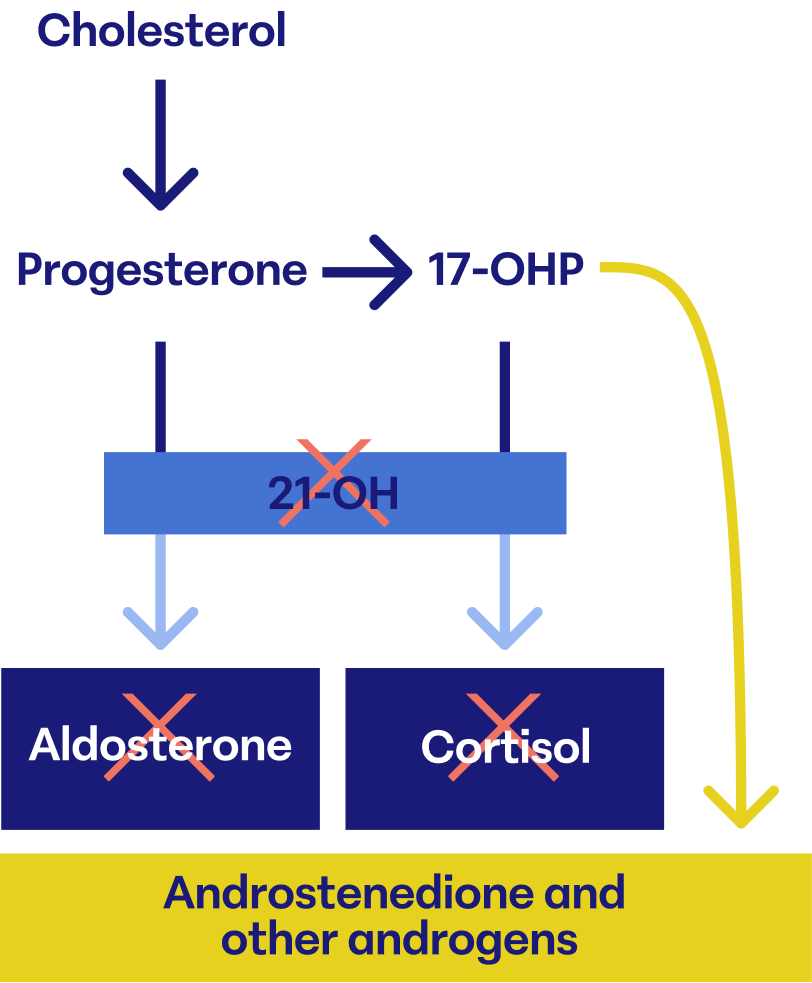
Most people with CAH have very little, if any, 21-hydroxylase (21-OH), which the body needs to make 2 important hormones: cortisol and aldosterone.
Without 21-OH, the building blocks for cortisol and aldosterone, like progesterone and 17-hydroxyprogesterone (17-OHP), pile up and instead are used to make androgens. As a result, androstenedione and other androgens are overproduced.
Today, CAH is usually detected at birth through newborn screening, which is standard in the United States.

An adrenal crisis is a life-threatening emergency that can happen when the body doesn’t have enough cortisol. While it’s especially critical to watch for in newborns with CAH, the risk doesn’t end there—it’s something everyone with CAH, at any age, needs to be prepared for.
Illness, injury, surgery, and strenuous exercise are times when the body naturally needs more cortisol. But for people with CAH who can’t produce enough cortisol on their own, this extra demand can quickly become dangerous.
That’s why it’s so important to have a stress dosing plan in place and to carry an emergency steroid injection kit. This helps ensure you have the extra cortisol you need in high-stress situations—and can save lives.
If vomiting, severe illness, or trauma occurs, don’t wait—give the emergency injection and seek medical help right away.
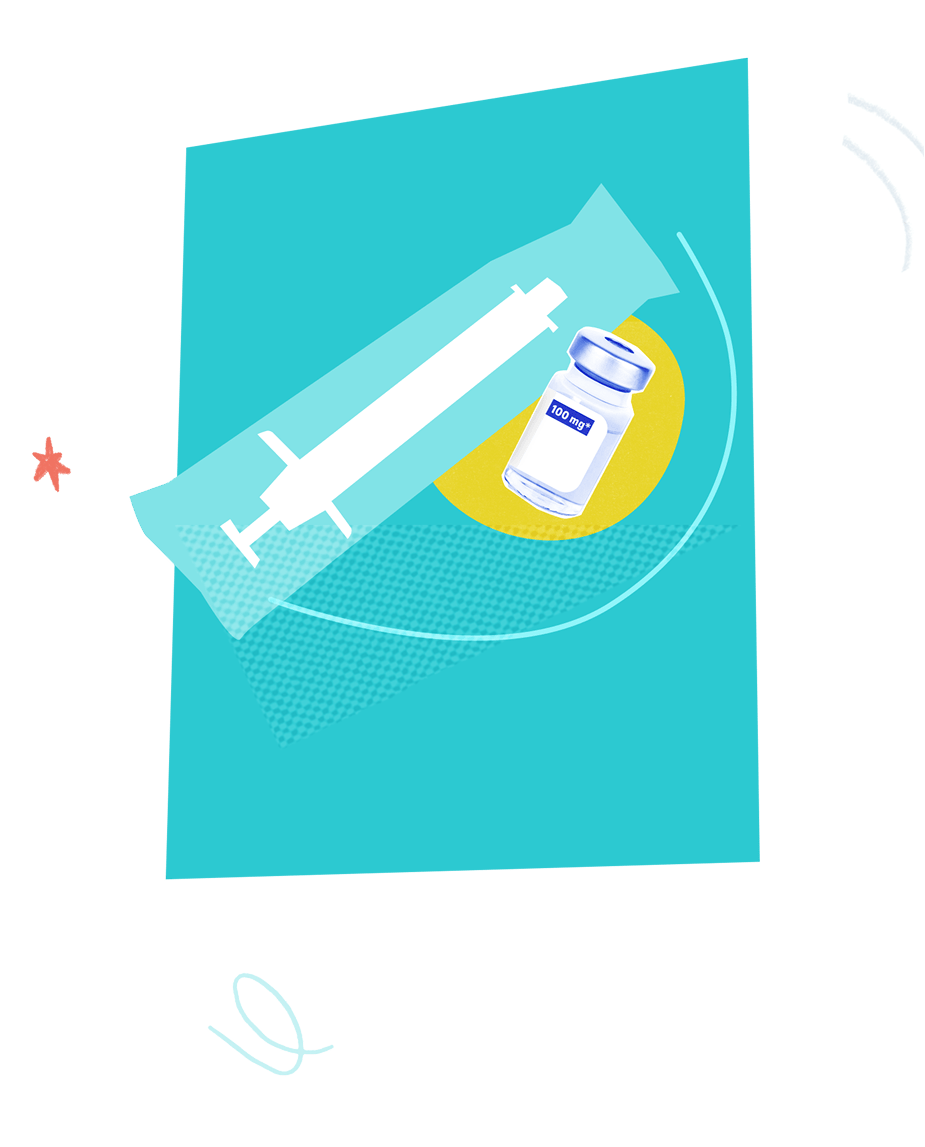
Give teachers/coaches, roommates, or other members of your support system clear instructions for how to help in case of an adrenal crisis. Download the Adrenal Crisis Emergency Action Guide.
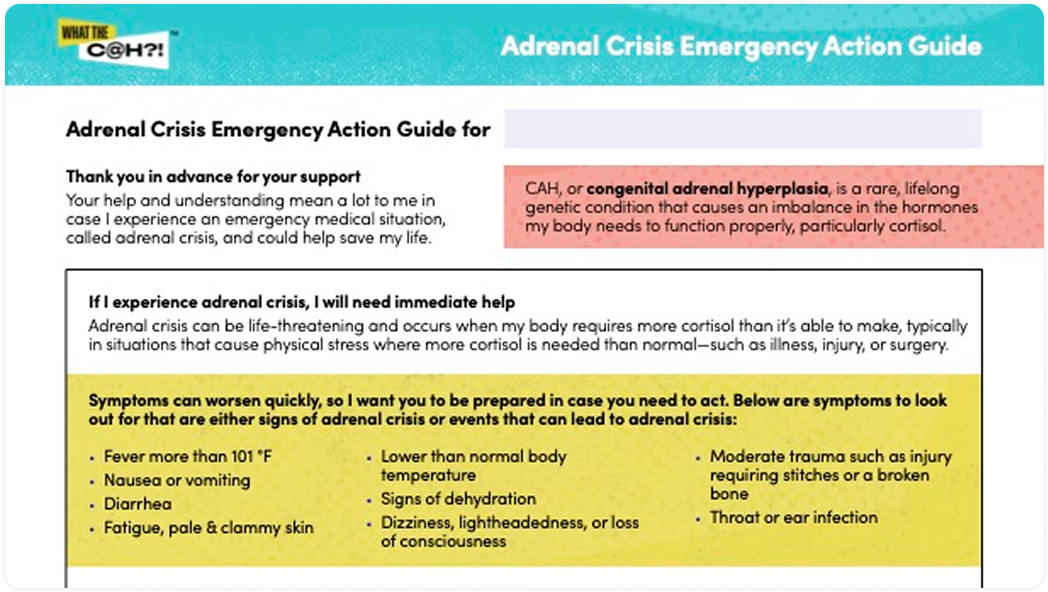
“Providing coaches and caregivers with information about emergency protocols helped our child participate fully in sports and daily life.”

Sign up for emails and get helpful tools and resources, real stories, and insightful tips for navigating life with CAH—straight to your inbox.
Thank you!
More to come—we’ll be in touch shortly.
