
Thank you!
More to come—we’ll be in touch shortly.

Frustrations and Challenges
Total length: 52 seconds
[Damon]
Hi, my name is Damon, and I have CAH.
[Damon]
Managing life taking high-dose steroids has been challenging.
I think the main thing that's really frustrating is that no matter how disciplined I am and how dialed in I am, there will always be that excess weight that I carry around.
Even when I was competing at a high level professionally, and I was in amazing shape, those fat stores are still going to be there.
And just realizing that you really do have to structure your life around your medication.
Another challenge is constantly wondering if you're on the right dose. I'm about to go into a stressful phase of life. Is my dosage correct? Do I need more? Do I need less?
But I don't want to let it hold me back from anything.
Impact of High Androgens
Total length: 43 seconds
[Meri]
Hi. My name is Meri, and my daughter has CAH.
[Meri]
You read about the excess androgens, specifically testosterone. And having a girl, you definitely don't want that.
And at the time, I thought that was just like a given, you know, she's going to have to deal with excess hair growth. She's going to have to deal with early puberty.
Now, I realize that with the right dosage, we can keep it properly managed.
So it's all about being better informed and finding the right resources to inform you.
The Challenges of High-Dose Steroids
Total length: 47 seconds
[Damon]
Hi, my name is Damon, and I have CAH.
[Damon]
The concerns of long-term use of high-dose steroids are many. But the main one right now is bone density.
I'm really nervous about, you know, what's going to happen whenever I'm 60. I'm 30 years old, and there's already been some findings of things going on with my back related to the high-dose steroids that I have been on my whole life.
Am I still going to be able to be as active? Am I still going to be able to maintain, you know, a lean body fat percentage so that I could do the things that I love, or will my body just slowly start going downhill?
The most important thing with managing my CAH long term is remaining as young as I can, for as long as I can.
Importance of Labs
Total length: 1:21
[Damon VO]
Hi. My name is Damon, and I have CAH.
[Meri VO]
Hi. My name is Meri, and my daughter has CAH.
[Damon]
I love getting my lab results back. And obviously, they're very objective data, which is really awesome.
With steroids, no matter how dialed in our treatment and dosages and everything is, there's always going to be either too little or too much androgens or even medication.
A frustration I have with treating CAH with steroids is that no matter how good the treatment is, it'll never be perfect.
[Meri]
So you're constantly trying to keep up with the labs, have to be getting them consistently to be checking what their levels are so that you know what the right dosage is.
And sometimes, maybe you'll get the lab and you'll be like oh, you actually need to increase your dose. And then by the time that you do, like they've already grown.
I think just trying to keep up with her growth and what her right dose is, is our biggest focus right now.
Thankfully, she's been really well managed. And you know, our endocrinologist has been great at just explaining what the labs mean and how to keep up with them.
Looking Toward the Future
Total length: 42 seconds
[Damon]
Hi, my name is Damon, and I have CAH.
[Damon]
My hope for the future of CAH is that we can move on with our daily lives and not have to carry as much emotional load about the treatments and managements and all the other little factors about CAH.
I find personally that a lot of endocrinologists just lean towards a higher steroid dose basically to keep you alive and out of adrenal crisis. But I want a doctor who's going to lean into treatments that are coming out.
I'm excited about the developments and treatment for CAH.
Tips and Advice
Total length: 46 seconds
[Meri]
Hi. My name is Meri, and my daughter has CAH.
[Meri]
Although experience is really important, you also want to find an endocrinologist who will listen to you and validate your concerns.
And just work with you as the parent in like understanding the things that you're telling them and the problems that you're seeing in your child.
Because sometimes just looking at the labs alone, it's not the full picture.
Just be aware that like not everyone is an expert, and like you might have to do your diligence and find the right doctor for your child.
Understanding CAH: A Guide to the Basics
Length: 3:28
Understanding CAH: A Guide to the Basics
[Adult VO 1 — female, 35-45]
One of my students this year has a condition I’m not familiar with. It’s called CAH.
[Adult VO 2 — male, early 30s]
A guy on my team at work told me he has CAH—I haven’t heard of it before.
[Adult VO 3 — female, early-mid 20s]
My new roommate let me know she has CAH.
[Adult VO 2 — male]
Wait. What is CAH?
[Narrator VO]
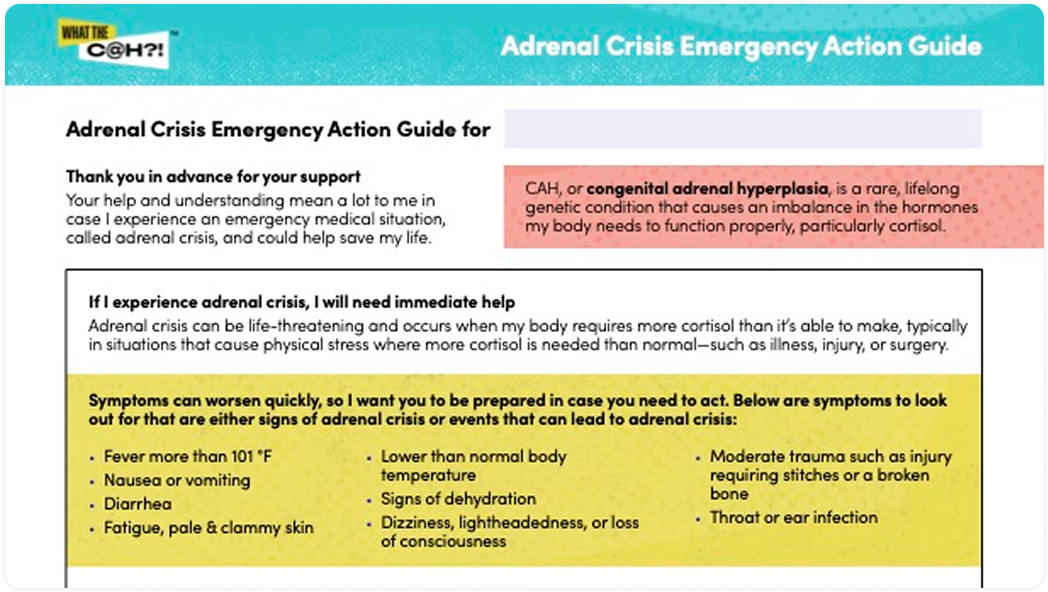
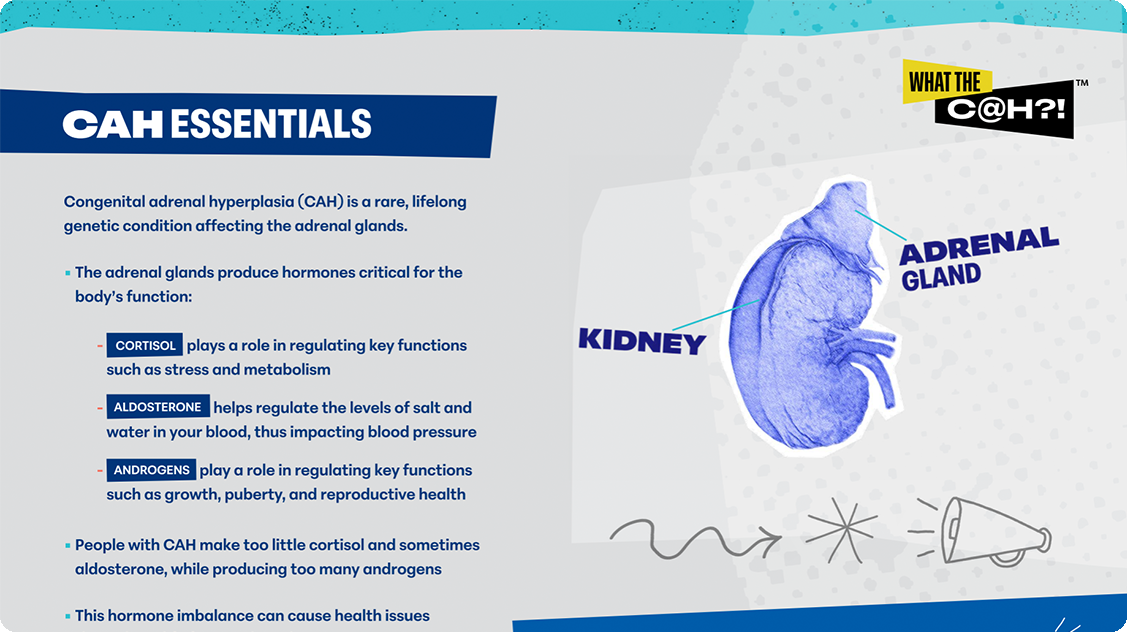
CAH, or congenital adrenal hyperplasia, is a rare, lifelong, genetic, condition.
CAH is usually detected at birth. In the United States, all newborns are now tested for CAH to help prevent complications and even death.
[Adult VO 3 — female]
It sounds serious.
[Narrator VO]
It is. But there are treatments that can help manage it and enable people with CAH to focus on living their lives.
[Adult 2 VO — male]
So, what does CAH mean for someone who has it?
[Narrator VO]
Well, CAH affects three important hormones that help our bodies function: cortisol, aldosterone, and androgens.
We all need cortisol to stay alive. It’s sometimes called the stress hormone, because your body makes extra when needed, like when you’re ill or you overexert yourself. Cortisol also regulates your metabolism. Together, cortisol and aldosterone help your body maintain a healthy blood pressure.
But in people with CAH, the body doesn’t make enough cortisol and aldosterone.
[Adult VO 2 — male]
We’re all under the weather from time to time. But my coworker says that when he’s feeling bad, it could be a sign of something much worse, especially if he feels nauseated, very weak, or dizzy.
[Narrator VO]
That’s right – for those with CAH, feeling unwell could be a warning for what’s called adrenal crisis—this is the life-threatening part of CAH, and it happens in situations when the body needs more cortisol than it’s able to make. There’s an emergency injection in case adrenal crisis happens.
[Adult VO 1 — female]
I carry that for my student on field trips. You also mentioned androgens – what do those have to do with CAH?
[Narrator VO]
When cortisol is low, the brain releases CRF—a signal received by CRF1 receptors in the pituitary gland. This sets off a chain reaction that, in CAH, contributes to excess androgens.
Androgens affect growth and reproductive health, but having too many can disrupt these processes in the body.
[Adult VO 3 — female]
My roommate says CAH makes her periods irregular, and that it might be harder for her to get pregnant because of her CAH.
[Narrator VO]
That’s right – fertility for both men and women can be impacted due to CAH. In kids, excess androgens can cause symptoms like early puberty and acne.
[Adult VO 3 — female]
I’m so glad to know all this. Besides the emergency injection, what other treatments are available?
[Narrator VO]
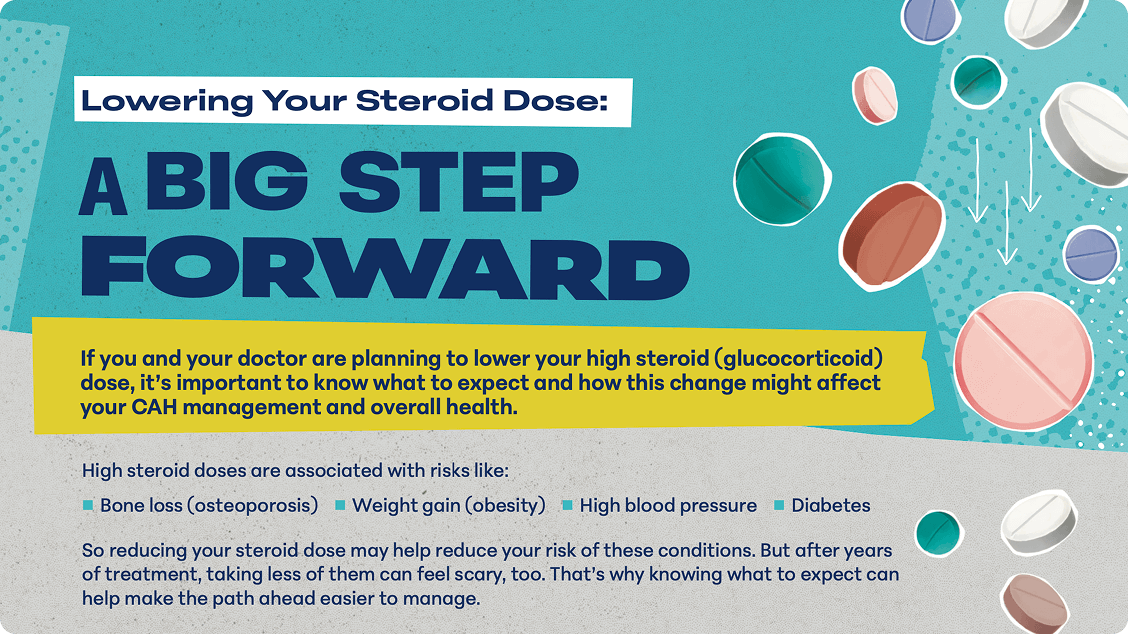
Prescription steroids called glucocorticoids and mineralocorticoids are used to replace cortisol and aldosterone. Sometimes higher doses of glucocorticoids are needed to help reduce excess androgens. However, these higher doses have drawbacks – they can cause side effects, some of them serious, such as weight gain, bone density issues, diabetes and even depression.
There’s another way to manage androgens too—one that works independently of steroids.
CRF1 receptor antagonists block the CRF signal at the source—reducing the chain reaction that can lead to excess ACTH and androgens.
They don't replace steroids, which are still used to replace missing cortisol—but they may help reduce the amount of steroids needed.
[Adult VO 1 — female]
I’m glad to know the basics, so I can help if necessary.
[Adult VO 2 — male]
It makes me feel like I can be there for them.
[Narrator VO]
CAH can be frustrating, but a supportive community could make it just a little bit easier.
The Science Behind CAH: What's Going On in My Body?
Length: 3:00
The Science Behind CAH: What's Going on in My Body?
[Adult VO 1 — Female, mid-30s]
Our doctor said some of my daughter's symptoms are caused by high androgens—not low cortisol.
[Adult VO 2 — Male, late 20s]
My doctor mentioned androgens as well. He said he gives me a higher dose of prescription steroids to lower my androgen levels.
[Adult VO 3 — Female, early 20s]
Wait, steroids are used to treat high androgens and low cortisol? WHAT THE CAH?!
[Narrator VO]
CAH can feel complicated. But breaking it down can make it easier to understand what's happening in your body.
Your body has a system that works automatically and is especially important during stressful situations. The system creates different types of hormones.
These hormones are signals that three organs – the hypothalamus, the pituitary gland, and the adrenal glands – use to work together.
Let's take a closer look.
The hypothalamus is a part of your brain. It's like the command center of the system. When you're stressed, it's the first to respond.
The pituitary gland receives hormone signals from the hypothalamus and then sends its own hormone signals to the next organ in the system, the adrenal glands.
The adrenal glands sit on top of the kidneys. It's their job to make cortisol, a hormone your body needs for a number of activities, including dealing with stress.
The whole system is called the hypothalamic-pituitary-adrenal axis. But that's a real mouthful, so it's usually just called the HPA axis for short.
[Adult VO 2 — male]
Do the organs really send each other signals?
[Narrator VO]
Yes—they use hormones to communicate with each other.
Here's how it works in someone who doesn't have CAH.
The hypothalamus makes a hormone called CRF to signal the pituitary gland.
When the pituitary receives CRF from the hypothalamus, it knows to make its own signal that will be sent to the adrenal glands. That's a hormone called ACTH.
When the adrenal glands detect ACTH, that's their signal to start making cortisol.
Once the adrenal glands have made enough cortisol, that's the signal for the hypothalamus to slow down the system.
It slows signaling for more cortisol until cortisol levels drop again.
[Adult VO 2 — male]
I know my body can't make much cortisol. Or it might not make any at all. Does that affect how the system works?
[Narrator VO]
It does! In people with CAH, there's not enough cortisol to send the signal to the hypothalamus.
[Adult VO 2 — male]
So the system doesn't know when to slow down.
[Narrator VO]
Exactly. It keeps going. The adrenal glands keep getting signals to make cortisol, but they can't make much, if any, due to a missing enzyme. Instead, they keep making the hormones they can make, which are androgens.
The result is, people with CAH make more androgens than the body needs.
[Adult VO 1 — female]
That explains why my daughter has high androgen levels.
[Narrator VO]
That's right. So there are really two issues for people with CAH—androgens that are too high and cortisol that is too low.
Prescription steroids are used to treat both. Steroids called glucocorticoids are used to treat low cortisol by replacing the missing cortisol in the body.
But to treat excess androgens, even higher doses of steroids are needed – more than the body would make on its own. For people with CAH, these high-dose steroids are what signal to the hypothalamus to slow down.
But high-dose steroids can have many side effects, some serious.
[Adult 2 VO — male]
They do! I've had a hard time with those. I wish I could take a lower dose. I'm going to talk to my doctor about it.
[Narrator VO]
Managing excess androgens with high doses of steroids can be a challenge. But a closer look at the HPA axis – especially the hormone signals between its parts – might provide alternative ways of thinking about treatment.
[Adult VO 1 — female]
It's not always easy to know what questions to ask our doctor. But this information makes me feel much more prepared for our next visit.
[Narrator VO]
The science behind CAH is complex. But knowing a little more about it, and about treatment, can help you advocate for your child or yourself.
Why Don't I Feel Good?
Length: 03:13
Why Don't I Feel Good? What the C@H?!
[Narrator VO]
Why don't I feel good? What the CAH?
[Adult VO 1 - male, 25-40]
Sometimes I just feel off and can't really explain it.
[Youth VO - female, 11-17]
Yeah…or I feel exhausted at the wrong time.
[Adult VO 2 - female, 25-40]
It's the acne for me. I thought I outgrew this!
[Narrator VO]
People with CAH, and those who care for them, may know the signs and symptoms. But what's happening inside the body can be less clear.
Let's take a closer look.
[Narrator VO]
Two of the key hormones affected by CAH are:
cortisol, which helps regulate stress responses and metabolism…
and androgens, which regulate growth and reproduction.
A third key hormone, aldosterone, also can be affected—but for now, let's focus on cortisol and androgens.
[Narrator VO]
For people with CAH, organs in your body called the adrenal glands don't produce enough cortisol.
So, a cortisol deficiency occurs—in other words, there's not enough of it being made.
In response, the brain keeps sending signals to produce more.
However, the same system that makes cortisol makes androgens as well. So it keeps signaling to produce cortisol, but androgens get made, which results in excess androgens.
This causes a range of CAH signs and symptoms. Some can be difficult to detect without lab tests, but others are more visible, such as acne and early puberty.
So, people with CAH need to be treated for both cortisol deficiency and androgen overproduction.
[Narrator VO]
That's where steroids come in. Steroids are taken every day to replace cortisol. But sometimes a person's regular steroid dose is not enough. When the body is stressed it needs more cortisol.
[Adult VO 1 - male, 25-40]
That explains why I need an extra dose sometimes, like when I have a cold.
[Narrator VO]
Exactly.
It's also important to know that steroids have another purpose, too. When used at higher doses, they can help reduce androgen overproduction.
But even with high doses of steroids, androgens may often still be too high in people with CAH. Plus, high doses of steroids can come with increased risks of weight gain, diabetes, high blood pressure, and other side effects that can affect people with CAH starting in childhood. Bone density loss can also affect people with CAH as early as their 20s and 30s.
[Adult VO 2 - female, 25-40]
Is there something I can do to better manage my androgen levels?
[Narrator VO]
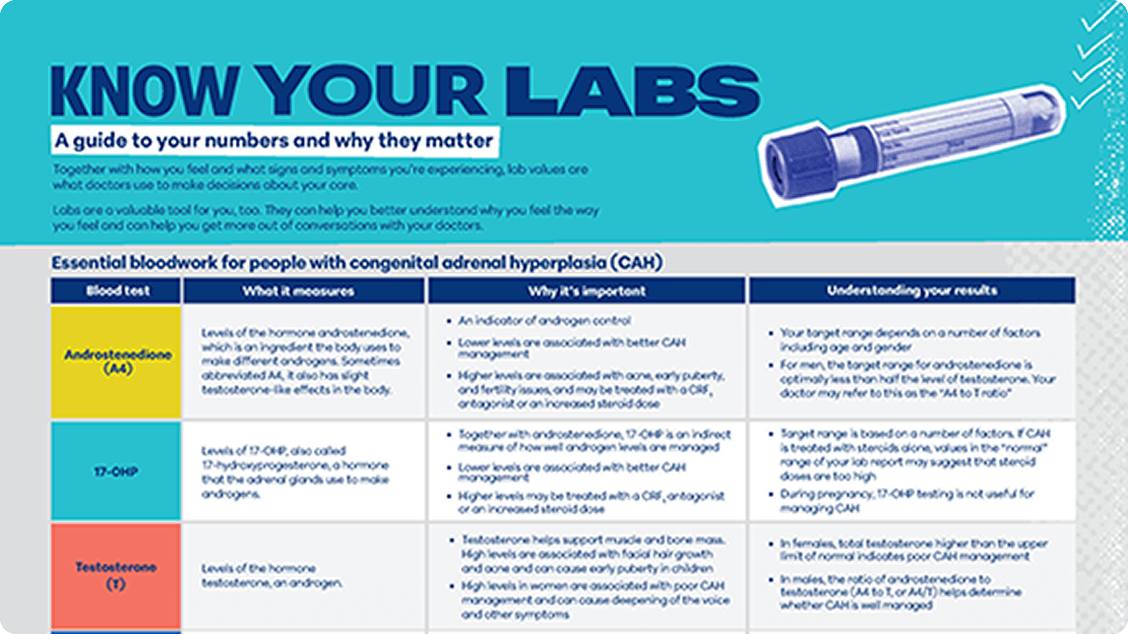
Understanding your lab results is key. Your endocrinologist will typically monitor the androgen markers androstenedione, or A4, and 17-hydroxyprogesterone, or 17-OHP.
You'll especially want to consult with your doctor and ask about your labs if you're noticing signs of androgen excess, like acne or increased hair growth.
As your symptoms and side effects change throughout your life, so may your treatment priorities. Your doctor might adjust your steroid dose over time to balance the risk of side effects with the symptoms of excess androgens.
[Adult VO 2 - female, 25-40]
Now that you mention it, my doctor has said she considers both what I'm experiencing and what my labs say.
[Narrator VO]
So at your next appointment, be sure to tell your doctor about how you've been feeling since your last visit, and if your goals for your treatment have changed at all. It could make a big difference in how you and your doctor manage CAH.
Is It a Symptom or a Side Effect?
Length: 01:58
[Narrator VO]
Is it a symptom or a steroid side effect?
[Parent VO]
But my kid is too young for body hair…
[SYMPTOM]
[Youth VO]
I used to be the tallest in my class.
[SYMPTOM]
[Youth VO]
Now that I'm in high school, I'm one of the shortest?
[SYMPTOM or SIDE EFFECT]
[Adult Female Patient VO]
I want to have kids—but will I be able to?
[SYMPTOM]
[Adult VO]
I eat well, but still gain weight!
[SIDE EFFECT]
[Adult VO]
I have A+ dental hygiene, but I've lost some teeth!
[SIDE EFFECT]
[Youth VO]
I'm bigger and slower than my friends,
[SIDE EFFECT]
[Youth VO]
and it makes me sad and angry.
[Youth VO]
I need high doses of steroids. But they cause all these other problems…
[Group VO]
What the CAH?!
[Narrator VO]
Life with congenital adrenal hyperplasia—CAH.
Cortisol and androgen hormones regulate key functions like stress responses, metabolism, puberty, and reproductive health.
Too little cortisol can make you feel tired and unwell, and may even lead to adrenal crisis.
Too much androgen can cause early puberty, premature growth, and more.
[DIABETES, INFERTILITY, EXCESS HAIR]
[Narrator VO]
With these imbalances, it's easy to see how CAH can really throw the body out of whack.
But treatment using high-dose steroids can cause side effects like weight gain, diabetes, and bone density issues.
[CARDIOVASCULAR PROBLEMS]
[Narrator VO]
What's tricky is that some of these side effects can be hard to detect or difficult to tell apart from the symptoms of CAH itself.
[Youth VO]
So, what can I do?!
[Adult VO]
And what can I do?
[Parent VO]
Me too…
[Narrator VO]
Well, you should talk to your doctor about what you're experiencing and your treatment plan. Because new side effects or symptoms, or even new changes in life, might necessitate changes in your treatment.
[Adult VO]
My health and priorities have changed as I've gotten older.
[INFERTILITY, CARDIOVASCULAR DISEASE]
[Adult VO]
And the last thing I want is another *bleep* moment!
[WHAT THE CAH?!]
[Narrator VO]
Don't let complacency set in. Have an honest conversation with your doctor—even if it's hard—and ask whether there are steps you can take to better manage CAH.

Sign up for emails and get helpful tools and resources, real stories, and insightful tips for navigating life with CAH—straight to your inbox.
Thank you!
More to come—we’ll be in touch shortly.
